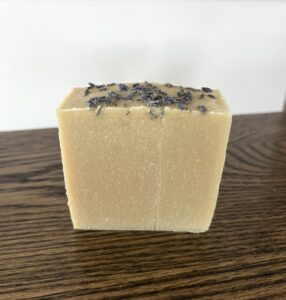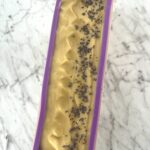
Simple Goats Milk Soap Base Recipe
This goats milk soap recipe is a wonderful base that fills a 42oz soap mold to the top. Add any additives like scented oils or colorants as you please.
Yield: 9 ~4.5 oz bars
Equipment
- 1 kitchen scale
- 1 immersion blender
- 1 stock pot
- 2 mixing bowls
- 1 silicone spatula
- 2 stainless steel spoons
- 1 soap mold
Materials
- 12.16 oz frozen goats milk
- 4.48 oz sodium hydroxide lye for solid soap bars
- 24.00 oz olive oil
- 8.00 oz avocado oil
Instructions
Prepare any at-trace ingredients
- If you are adding oatmeal, flower petals, herbs, colorants, or essential/fragrance oils, get those prepared and measured.
- Set aside for when the soap comes to a light trace when you can add these ingredients into the mixture.
Frozen Goats Milk
- It is a good practice to measure out goats milk ice cubes first and set aside about 15 minutes before doing any other process. This gives the frozen milk a few minutes to melt a little before adding the lye. The water/milk that has melted some kick starts the lye heating process.
Oil Temperature
- After measuring and setting out the frozen milk cubes, heat the measured oils in a stock pot over low heat until all of the coconut oil has melted. Stir constantly and remove from heat as soon as there are only a few pieces of coconut oil floating around.
- Continue to stir the oils until all coconut oil is melted.
- Check the temperature of your oils using thermometer. It could be anywhere from 110-140 degrees. The oils will need to come down to under 100 degrees for this recipe. Allow the oils plenty of time to come down to that temperature.
- This can take 20 minutes, give or take. Check the temperature often.
Back to the Goats Milk and Lye
- Slowly sprinkle lye on top of the frozen goats milk and stir and mix constantly (eye ball approximately 2 tablespoons of lye at a time). Add more lye every couple of minutes. Continue to stir the mixture around carefully.
- Do this on repeat until all of the lye is in the milk mixture.
Oils and Lye Temperatures
- Using a thermometer, measure the temperature of both the oils and lye, making sure to wipe the stick with a paper towel between bowls.
- When the temperatures are between 95 and 85 degrees for both or either oils pot and goat’s milk lye, you can add the lye-milk mixture to the oils and begin blending with an immersion blender.
- *Note: once while making a batch, the lye-milk mixture’s temperature was only 73 degrees. That seemed quite low to me so I used a double broiler method to sit the lye-milk mixture in to reheat to about 85 degrees then mixed the lye-milk with the oils. While I reheated the mixture, I made sure to continue to stir it in hopes the milk would not scorch and it did not.
Bring soap to trace
- Use an immersion blender to incorporate the lye-milk and oils for saponification to occur for a series of 5 sets of 1 minute of blending, 2 minutes of rest or until the soap reaches light trace. These sets are give or take. Could be more sets, could be less. Keep looking for the light trace!
- You will know the soap is at light trace when you drizzle the soap mixture over the surface of the soap in the pot and it leaves behind a trail or a trace that doesn’t go away. It sits right on top.
- If you are adding any essential or fragrance oils, colorants, or herbs/flowers; this is the step when you add those then blend again for another 30 seconds.
Pour and Let Sit
- Once all ingredients are well incorporated, carefully pour the soap into the soap loaf.
- Then cover the soap loaf with parchment paper then a towel and allow it to rest in a safe place for 18-24 hours.
Cut and Cure
- The next day, it is safe to cut the soap into bars to sit and cure for about 4 weeks, perhaps a little more if the soap bars still feel soft.
Notes
NOTES: I choose to cut my soap bars at a 2.5 on the cutter that came with my soap loaf kit. This yields about a 4.5 oz bar of soap, generally 9 bars.
More recipes like this found at www.johnsonhomeNC.com