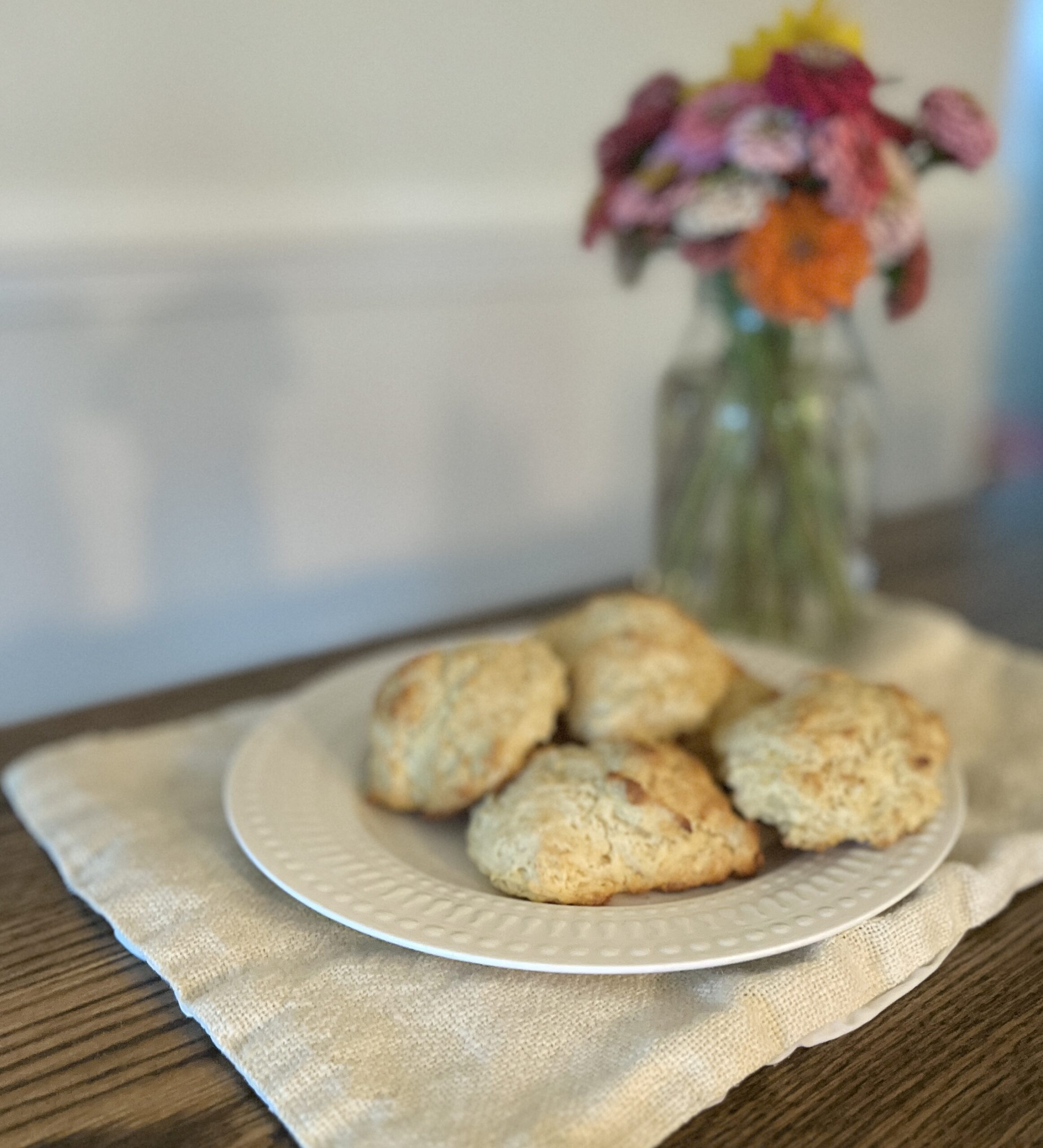
Goats milk soap boasts too many great skin care properties to ignore. This goats milk soap recipe is a wonderful base to work with to add fragrance or colorants to as you desire. Starting with fresh then frozen goats milk, it’s a fast recipe to whip up! Read on to find out how to make simple goats milk soap base.

This post contains affiliate links, which means I make a small commission at no extra cost to you. Always shop small, local, and/or direct when you can, though!
An Updated Goats Milk Soap Recipe
Originally, I shared this goats milk soap recipe that is comprised of fresh but frozen goats milk, ground oatmeal, and local raw honey.
It needs no accompaniment. This naturally and light scented homemade soap is perfect for skin all over, including face. I love it; however, I found a much better way to use this recipe for a goats milk based soap so additives can be included as desired.
The issue I had with the original recipe is that it wasn’t quite 2 pounds of soap to fit my mold. I like for my soap recipes to be 32 ounces of fats/oils. This way when I cut the soap into bars on my cutter at a 2 1/2, the soap bars weigh somewhere between 4 and 5 ounces, generally around 4.5 oz.
This new and improved simple goats milk soap recipe is the perfect base for using essential oils or fragrance oils to scent your homemade soap and/or colorants as you desire.
How is this goats milk soap recipe ‘simple’?
Cold-process goats milk soap has become my favorite soap to work with because due to the milk needing to be frozen first to discourage scorching, it shortens the soap making time significantly.
“Simple” could also mean “efficient” in this recipe.
Handling LYE in soap making
When handling lye, always remember:
- wear long sleeves
- don safety glasses (not your regular eye glasses or sunglasses)
- long kitchen gloves or short latex/vinyl examination gloves making sure long sleeves are covering wrist and arm.
- a mask such as an N95
- LYE TO WATER! Or in this case, slowly adding a little lye at a time to the frozen milk cubes and carefully stirring. NEVER add water to lye!
- Be in a ventilated area, preferably outside, when mixing the lye onto the frozen ice cubes of milk.
- Let your family and children know what you are doing and that you need a few minutes without them near it
- NO distractions! If you have little ones, consider doing this at nap time or bed time or when someone else is supervising the children.
- Soaping needs your FULL attention.
Prepare the goat’s milk first
Before diving straight into making this simple goats milk soap recipe, it’s important to freeze the goat’s milk.
Using ice cube trays work well for this project.
The reason the milk needs to be frozen first is because it is replacing the water in this soap recipe.
Since the lye heats up so quickly and in high heat when in contact with the liquid (the water content in the milk), the milk can scorch and become discolored.
Using frozen milk allows the lye not to get too hot too fast.
The freezing milk process needs 8-10 hours before it’s ready to be used to make goat’s milk soap.
Simple Goats Milk Soap Coloring
It should be noted that goats milk soap can take on a brown color. Sometimes it’s light brown and sometimes it’s dark brown.
Dark brown is likely due to some scorching.
If the goats milk is not continuously stirred while you are adding lye to the frozen milk in sections, the lye-milk mixture will turn a yellow-ish color that I have found makes the cured soap more dark brown.
Johnson Home, LLC Homemade Soaps doesn’t use colorants of any sort (not even mica) so how the brown of this easy goats milk soap recipe turns out isn’t an issue for us but it may be for you if you choose to use colorants.

Cold-Process Simple Goats Milk Soap Ingredients
**NOTE: this recipe uses FRESH, frozen goats milk; NOT powdered goats milk.
Measure ALL ingredients individually first and set aside before mixing.
12.16 oz frozen goats milk
4.48 oz sodium hydroxide (lye for solid soap bars)
24.00 oz olive oil
8.00 oz avocado oil
Prepare any at-trace ingredients
If you are adding oatmeal, flower petals, herbs, colorants, or essential/fragrance oils, get those prepared and measured now.
Set aside for when the soap comes to a light trace when you can add these ingredients into the mixture.
Frozen Goats Milk
It is a good practice to measure out goats milk first and set aside before doing any other process. This gives the frozen milk a few minutes to melt a little before adding the lye. The water/milk that has melted some kick starts the lye heating process.
Adding lye to completely frozen milk can cause the lye mixture to not reach a hot enough temperature. This can cause a “false trace” when combining lye-milk mixture with the oils/fats.
I’ve found success with measuring and allowing the frozen milk to sit out for about 15 minutes before I begin the process.
Oil Temperature
After measuring and setting out the frozen milk cubes, heat the measured oils in a stock pot designated for soaping (not for cooking) over low heat until all of the coconut oil has melted. Stir constantly and remove from heat as soon as there are only a few pieces of coconut oil floating around. They will fully melt soon.
Continue to stir the oils until all coconut oil is melted.
Check the temperature of your oils using a candy thermometer or stick thermometer. It could be anywhere from 110-140 degrees. The oils will need to come down to under 100 degrees for this recipe. Allow the oils plenty of time to come down to that temperature.
The temperature of your soap making space will affect how fast or slow the oils comes down to under 100 degrees. Be patient. Don’t rush the process.
This can take 20 minutes, give or take. Check the temperature often.
Back to the Goats Milk and Lye
Now put your attention on the goats milk and lye while the oils cool down.
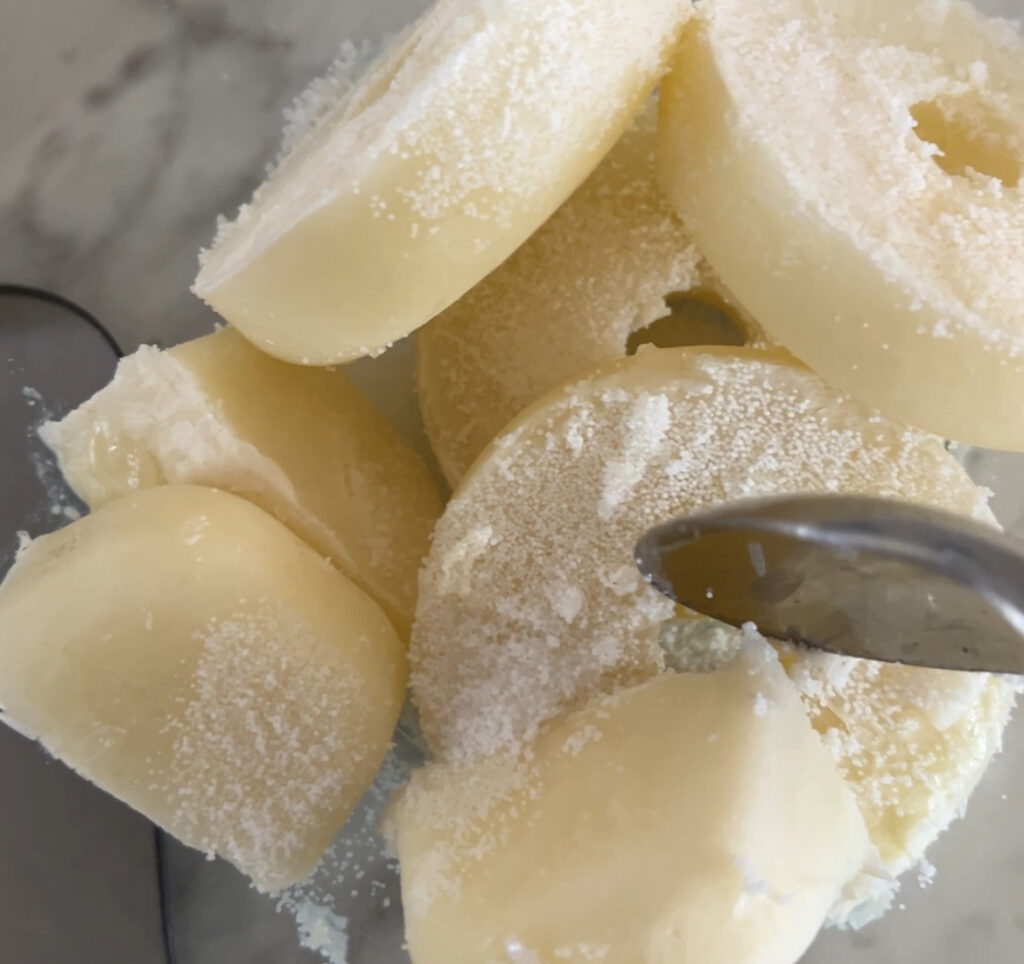
Slowly sprinkle lye on top of the frozen goats milk and stir and mix constantly (eye ball approximately 2 tablespoons of lye at a time). Add more lye every couple of minutes. Continue to stir the mixture around carefully.
Do this on repeat until all of the lye is in the milk mixture.
You may notice the milk take on a gritty look as the lye dissolves the frozen milk. Honestly, I am not sure what it is. Is it something to do with the fat content in the milk? I can’t say for sure but what I can say is that it does not affect the soap’s final product.
Oils and Lye Temperatures
Using a thermometer, measure the temperature of both the oils and lye, making sure to wipe the stick with a paper towel between bowls if using that type of candy thermometer.
When the temperatures are between 95 and 85 degrees for both or either oils pot and goat’s milk lye, you can add the lye-milk mixture to the oils and begin blending with an immersion blender.
*Note: once while making a batch, the lye-milk mixture’s temperature was only 73 degrees. That seemed quite low to me so I used a double broiler method to sit the lye-milk mixture in to reheat to about 85 degrees then mixed the lye-milk with the oils. While I reheated the mixture, I made sure to continue to stir it in hopes the milk would not scorch and it did not.
Bring soap to trace
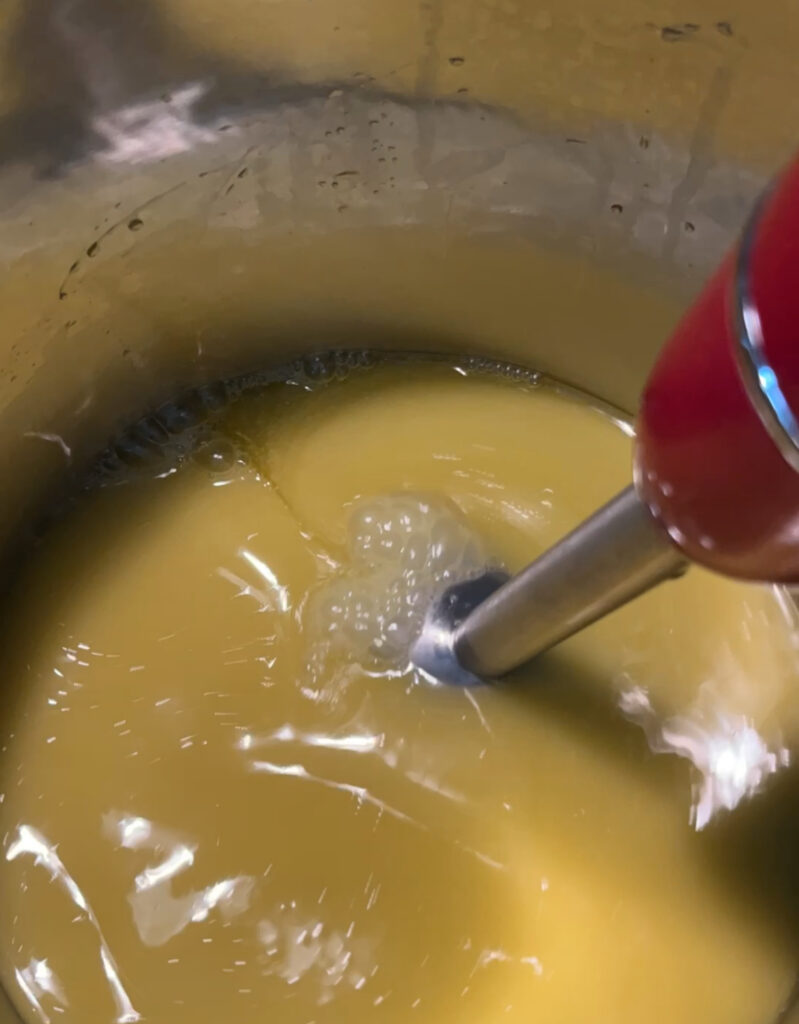
With this simple goats milk soap recipe, you’ll want to blend the lye-milk and oils together until they reach light trace.
Use an immersion blender to incorporate the lye-milk and oils for saponification to occur for a series of 5 sets of 1 minute of blending, 2 minutes of rest or until the soap reaches light trace. These sets are give or take. Could be more sets, could be less. Keep looking for the light trace!
You will know the soap is at light trace (explained and shown in that link) when you drizzle the soap mixture over the surface of the soap in the pot and it leaves behind a trail or a trace that doesn’t go away. It sits right on top.
If you are adding any essential or fragrance oils, colorants, or herbs/flowers; this is the step when you add those then blend again for another 30 seconds.
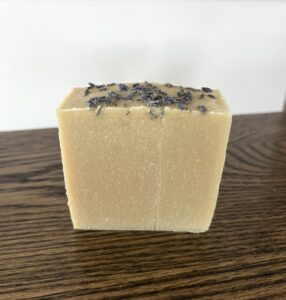
This goats milk soap base recipe makes a great “naked goats milk soap”. No scent, no color. Just mild skin cleansing soap.
Pour and Let Sit
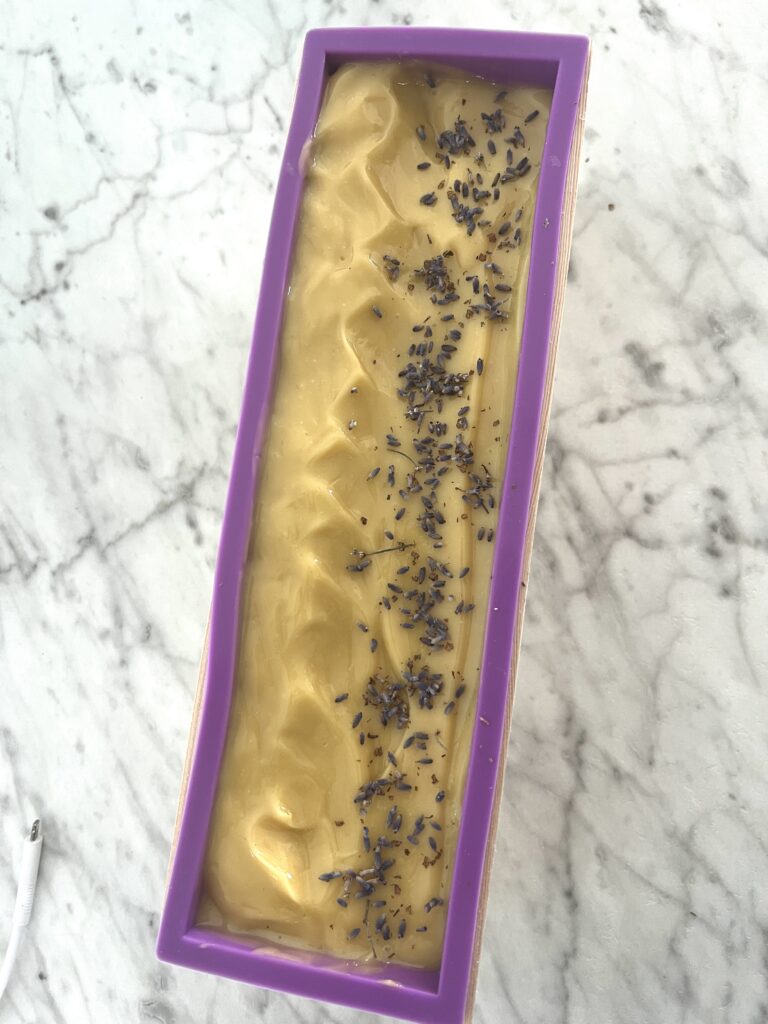
Once all ingredients are well incorporated, carefully pour the soap into the soap loaf.
Then cover the soap loaf with parchment paper then a towel and allow it to rest in a safe place for 18-24 hours.
Cut and Cure
The next day, it is safe to cut the soap into bars to sit and cure for about 4 weeks, perhaps a little more if the soap bars still feel soft.
I choose to cut my soap bars at a 2.5 on the cutter that came with my soap loaf kit. This yields about a 4.5 oz bar of soap.
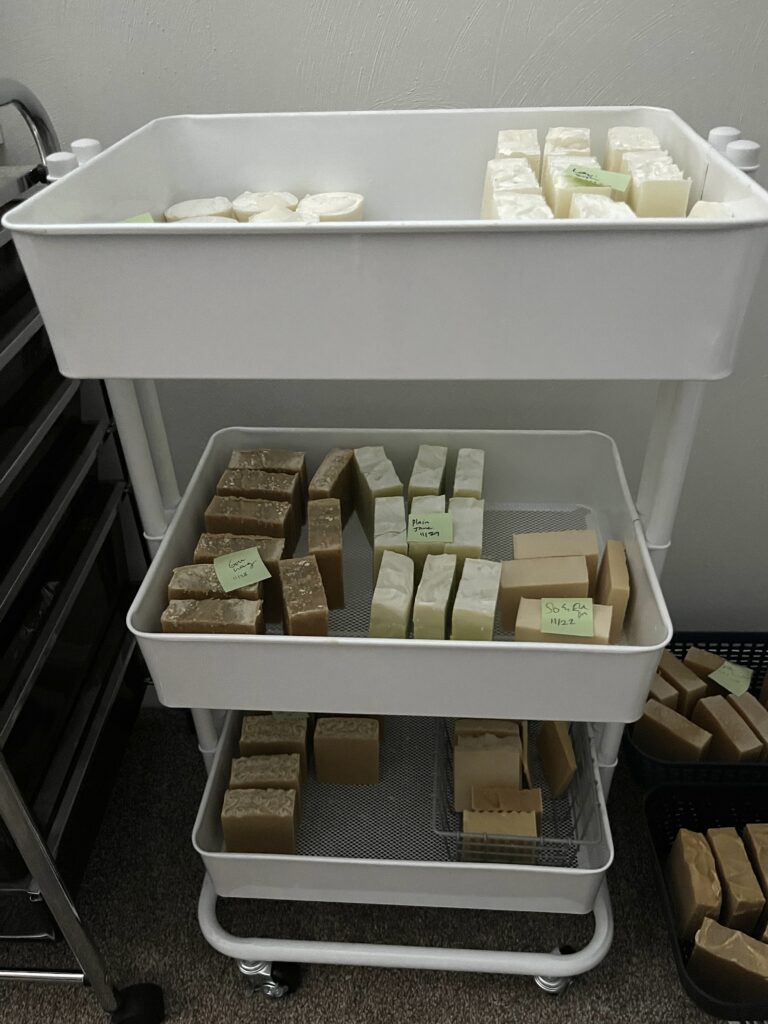
Curing may take 4-6 weeks when soap bars are allowed to sit in a ventilated basket or on shelving. If ventilated options are not available, be sure to flip the soap bars every other day to allow full and complete curing and proper air flow.
This is the cart I use to store curing soap bars on. Lots of air flow from all sides so I do not need to rotate the bars.
Soap Clean Up
It is a good practice to keep the gloves on when cleaning up your soap work space and washing the dishes.
Why is goats milk a great soap ingredient?
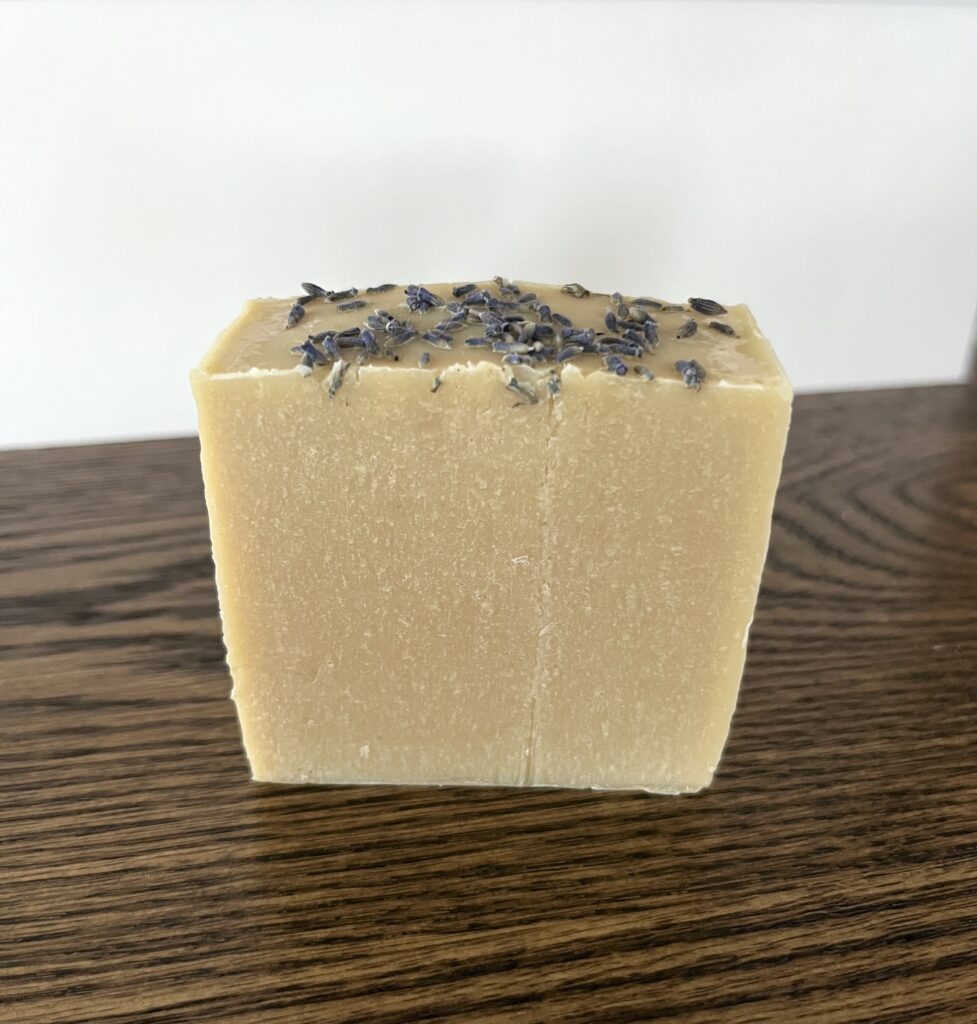
Goats milk offers a naturally creamy and gentle effect to this mildly cleansing soap. It is perfect for use on whole body and even face! This simple goats milk soap could be a great option for sensitive skin and baby’s skin too.
This milk contains vitamins A, B, C, D, E and lactic acid, which gently exfoliates skin.
Lastly, goats milk is very similar in pH to human skin which helps the skin to maintain their natural skin oils versus what many detergent-based soaps do, which is strip the skin of its natural oils. Doing this can sometimes cause the skin to rapidly produce more oil which can cause oily skin and break outs.
PLEASE SEE MY DISCLOSURE STATEMENT!
SHOP THIS POST
Sodium hydroxide (lye for solid soap bars)
More soap recipes by Johnson Home
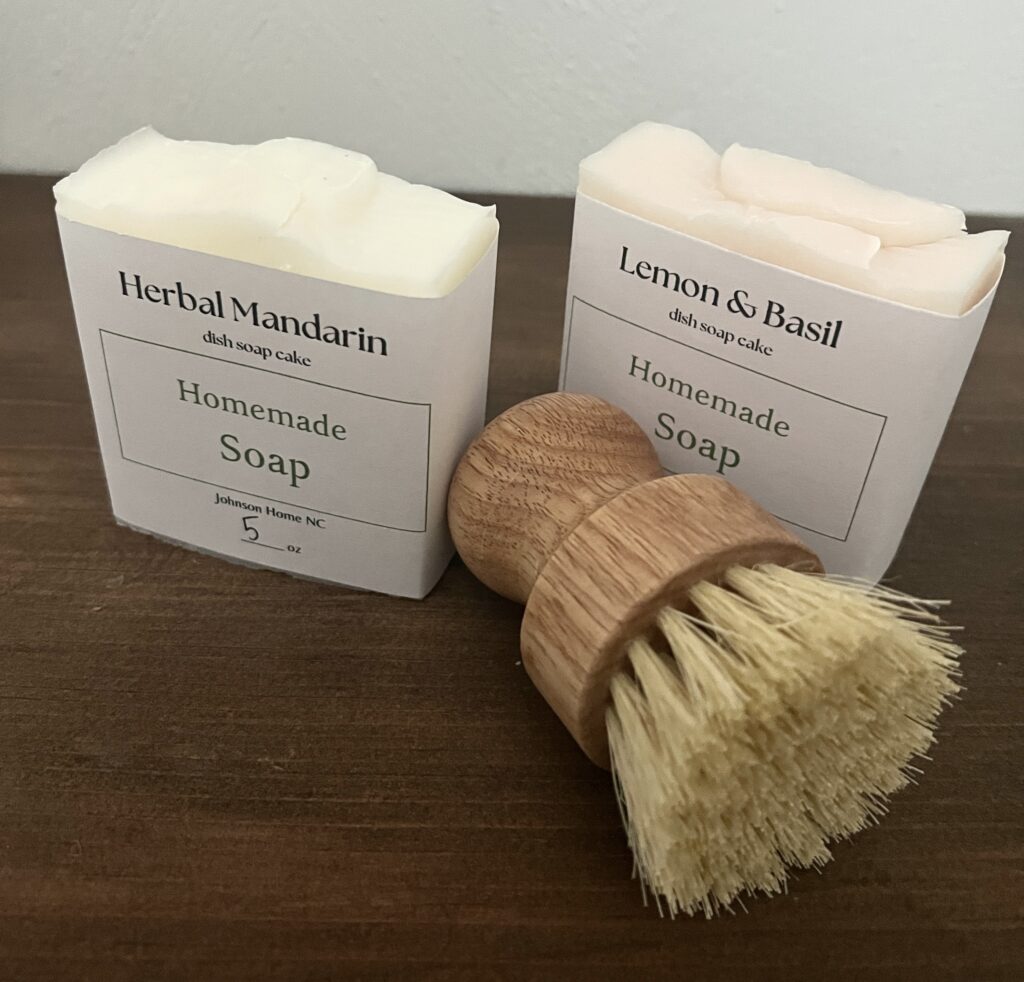
Goats Milk, Oatmeal, and Honey Soap

The Goats Milk Soap Base Recipe
Simple Goats Milk Soap Base Recipe
Equipment
- 1 kitchen scale
- 1 immersion blender
- 1 stock pot
- 2 mixing bowls
- 1 silicone spatula
- 2 stainless steel spoons
- 1 soap mold
Materials
- 12.16 oz frozen goats milk
- 4.48 oz sodium hydroxide lye for solid soap bars
- 24.00 oz olive oil
- 8.00 oz avocado oil
Instructions
Prepare any at-trace ingredients
- If you are adding oatmeal, flower petals, herbs, colorants, or essential/fragrance oils, get those prepared and measured.
- Set aside for when the soap comes to a light trace when you can add these ingredients into the mixture.
Frozen Goats Milk
- It is a good practice to measure out goats milk ice cubes first and set aside about 15 minutes before doing any other process. This gives the frozen milk a few minutes to melt a little before adding the lye. The water/milk that has melted some kick starts the lye heating process.
Oil Temperature
- After measuring and setting out the frozen milk cubes, heat the measured oils in a stock pot over low heat until all of the coconut oil has melted. Stir constantly and remove from heat as soon as there are only a few pieces of coconut oil floating around.
- Continue to stir the oils until all coconut oil is melted.
- Check the temperature of your oils using thermometer. It could be anywhere from 110-140 degrees. The oils will need to come down to under 100 degrees for this recipe. Allow the oils plenty of time to come down to that temperature.
- This can take 20 minutes, give or take. Check the temperature often.
Back to the Goats Milk and Lye
- Slowly sprinkle lye on top of the frozen goats milk and stir and mix constantly (eye ball approximately 2 tablespoons of lye at a time). Add more lye every couple of minutes. Continue to stir the mixture around carefully.
- Do this on repeat until all of the lye is in the milk mixture.
Oils and Lye Temperatures
- Using a thermometer, measure the temperature of both the oils and lye, making sure to wipe the stick with a paper towel between bowls.
- When the temperatures are between 95 and 85 degrees for both or either oils pot and goat’s milk lye, you can add the lye-milk mixture to the oils and begin blending with an immersion blender.
- *Note: once while making a batch, the lye-milk mixture’s temperature was only 73 degrees. That seemed quite low to me so I used a double broiler method to sit the lye-milk mixture in to reheat to about 85 degrees then mixed the lye-milk with the oils. While I reheated the mixture, I made sure to continue to stir it in hopes the milk would not scorch and it did not.
Bring soap to trace
- Use an immersion blender to incorporate the lye-milk and oils for saponification to occur for a series of 5 sets of 1 minute of blending, 2 minutes of rest or until the soap reaches light trace. These sets are give or take. Could be more sets, could be less. Keep looking for the light trace!
- You will know the soap is at light trace when you drizzle the soap mixture over the surface of the soap in the pot and it leaves behind a trail or a trace that doesn’t go away. It sits right on top.
- If you are adding any essential or fragrance oils, colorants, or herbs/flowers; this is the step when you add those then blend again for another 30 seconds.
Pour and Let Sit
- Once all ingredients are well incorporated, carefully pour the soap into the soap loaf.
- Then cover the soap loaf with parchment paper then a towel and allow it to rest in a safe place for 18-24 hours.
Cut and Cure
- The next day, it is safe to cut the soap into bars to sit and cure for about 4 weeks, perhaps a little more if the soap bars still feel soft.
Notes
Follow the blog for more like this
Feel free to follow Johnson Home NC on Facebook, Instagram, Pinterest, and YouTube.
Allow me to slip into your email inbox weekly with kitchen, gardening, natural cleaning, and chicken raising real time happenings from our one acre North Carolina homestead right to you by joining our email list HERE.