Chicken processing day is a day when you want efficiency with safety. A plan of action is important as well as knowing where your stations are and how to run them smoothly. Over the last 3 years of processing our own backyard meat chickens, we have changed up the flow as well as added new equipment each processing day to make things run smoother with the hopes of one day raising more chickens. Here is our chicken processing set up 2025 update.

Disclaimer: this is just how we do it. This post is meant to inspire you with ideas of how you can set up your own chicken processing day stations. There are likely better and more efficient ways of doing it. Much of the equipment featured in this post has been budgeted and saved up for as they are not inexpensive purchases. Chicken harvesting can be done on a much simpler level with little to no costs. Take what you’d like from here, leave the rest, and happy chicken day!
This post contains affiliate links, which means I make a small commission at no extra cost to you. Some links are directly from the company’s website and I am not affiliated or paid by that company in any way. Always shop small, local, and/or direct when you can!
Start where you are with what you have
There is no need to go out and spend more money on equipment if you are not at a place to do so yet.
Utilize your Facebook friends list as well as Marketplace. Look for free items people are clearing out.
- pallets
- buckets
- cement blocks (or raising up your cleaning stations to save your back!)
- tarps (for easy cleaning)

Free pallets are still used 3 years later on chicken day as well as free five gallon buckets. Some will need to be replaced this March but we were able to get 5 rounds of birds through those killing cones. That’s slightly less than 250 birds for us.
See how to make a killing cone for less than $5 here. Or if you have the money, buy processing cones.
I have seen a friend use their tall city waste management trash can handle for holding a killing cone.
The tailgate of a truck works well as a cleaning station if needed. Be sure to sanitize it well or put down a clean tarp.
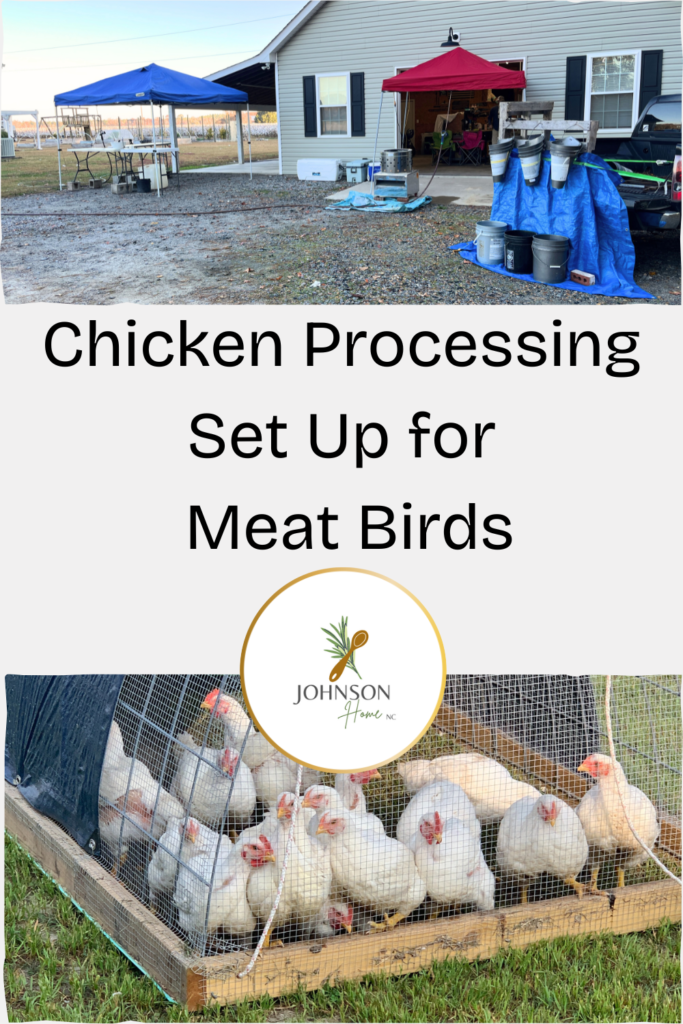
Chicken Processing Stations as of November 2025
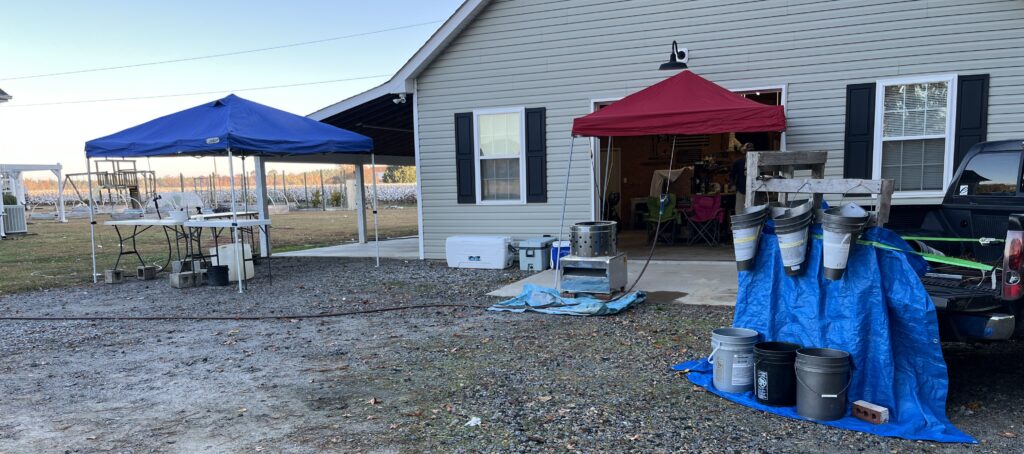
From left to right:
Cleaning/Eviscerating Station
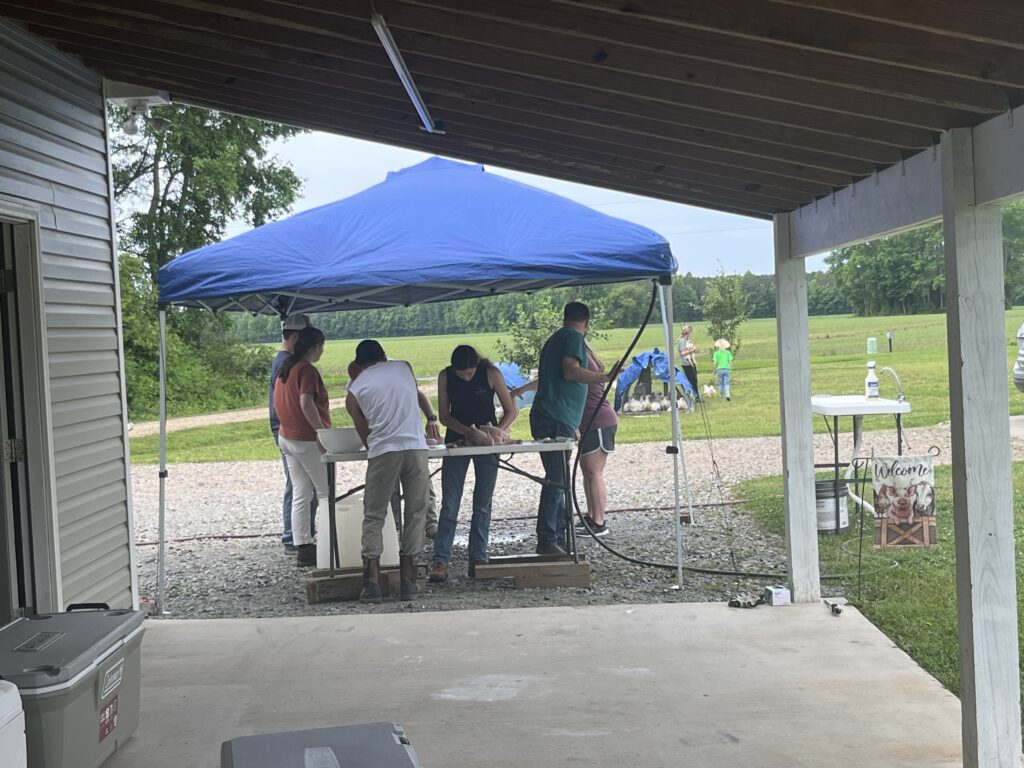
Blue tent is the cleaning/eviscerating station with two lifted up folding plastic tables serve as cleaning stations with a water hose hung by a bungee cord for easy access.
A white gut bucket is made from a 55 gallon drum (free from brother who has access to triple washed drums) that has been cut in half.
Tables are washed with soap and water after set up, before any bird cleaning begins. Then each table is rinsed between each bird cleaned. If any bile from an accidental gall bladder bust or poop gets on the table, remove bird immediately, rinse very well, then wash the cleaning area with soap and water again before finishing the bird.
Cleaning station is meant to be kept clean at all times. Shade is important on sunny or hot days.
Coolers
Four coolers: one for finished chicken resting in ice water before being bagged, one for chilling chicken after scaling and plucking, one half filled with just ice for resting after bagging, and one last cooler for extra ice as needed.
Plucking and Scalding Station
Red tent is the plucking and scalding station. Pictured is a CoopNMore Chicken Plucker (my unpaid, honest review) with a water hose on a bungee cord for easy access and to save the back from bending to pick up the water hose nozzle often.
Not pictured, or hidden from view here, is the turkey frying pot over a camp stove of propane heat used as a one bird scalder.
- the tarp in front of the plucker is for ease of cleaning as well. Feathers shoot out of the plucker onto the tarp then we drag the tarp wherever we want to dispose of or compost the feathers.
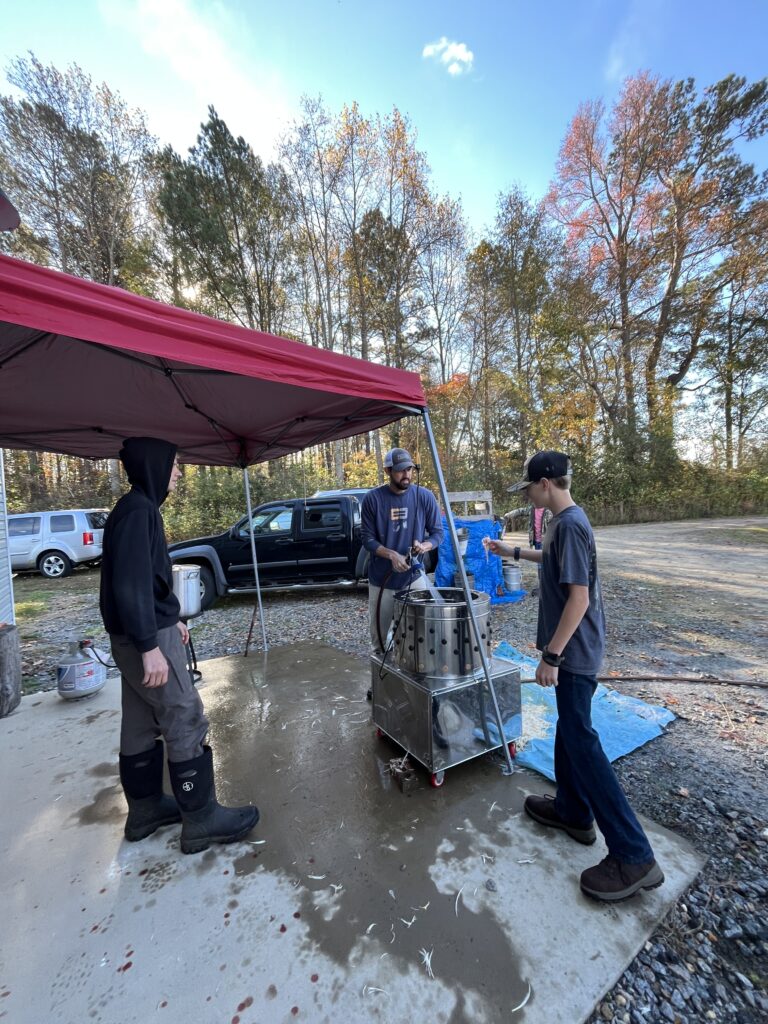
- for scalding, we use a little dish soap (recently switched from Dawn to Castile soap for less chemical toxins and didn’t notice a difference in how to soap worked as a surfactant so that’s a plus!)
- if using Castile soap, pay attention to the ingredient list. Some castiles are made with tree nut oils, some are not.
- dish soap used every 10 birds or so and about 2 tsp worth
- changed scalding water once for November 2025 48 birds
- recently upgraded to a Stromberg’s Scalder that we will use in May 2026
- scalding water is kept around 145 degrees as best we can on propane heat, keeping a check on it often with a thermometer
- rinse bird before putting into the scalding water, if needed. Sometimes the bird will have poop on it or if you want to rinse away some of the blood.
- scald bird for about 30 seconds, using a pole or stick to keep bird under the water and swirled around.
- test by pulling on a large wing feather. If it removes easily, the bird is ready for the plucker.
Chicken Killing Cone Station
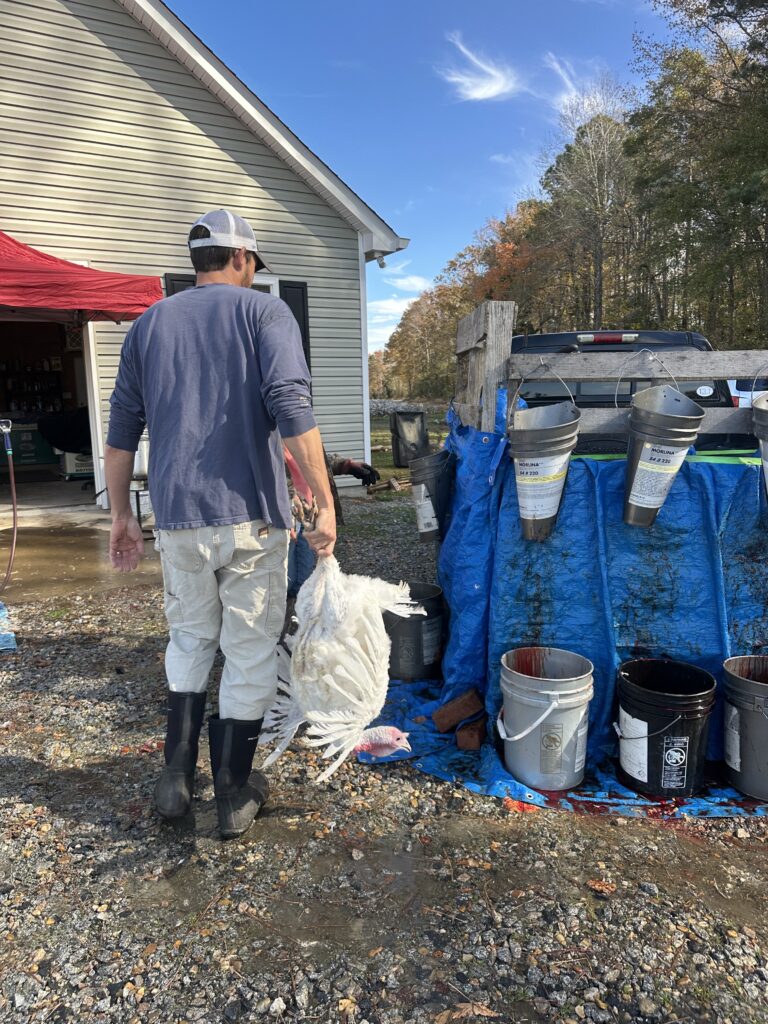
Black truck is the chicken killing cone station. The truck bed is used as a prop for the pallets which are cone holders. We have added a 4th cone which has helped speed up the entire chicken processing day.
- tarps are used as a protection from blood splatter. Simply makes clean up a lot easier.
- ratchet straps (green in the picture) are used to hold the pallets steady.
Bagging Station
Not pictured is the bagging station which is inside of the workshop.
Yes that is a blessing to have!
If you look above the blue tent in the photo a bit further up, there is a lean-to that has a man door leading into the workshop.
After birds are cleaned and rinsed, they are put into an ice bath cooler by the man door. We have a bagger inside the workshop who collects the birds from the ice bath, bags, and weighs the birds before putting the birds back on just ice to cool.
- cooling birds: this will be a matter of preference but we have found much tender meat when we allow the meat chickens to chill on ice in coolers for 4-5 days before adding them to the freezer camp. Drain water from the coolers and add ice as needed as you check on the birds daily.
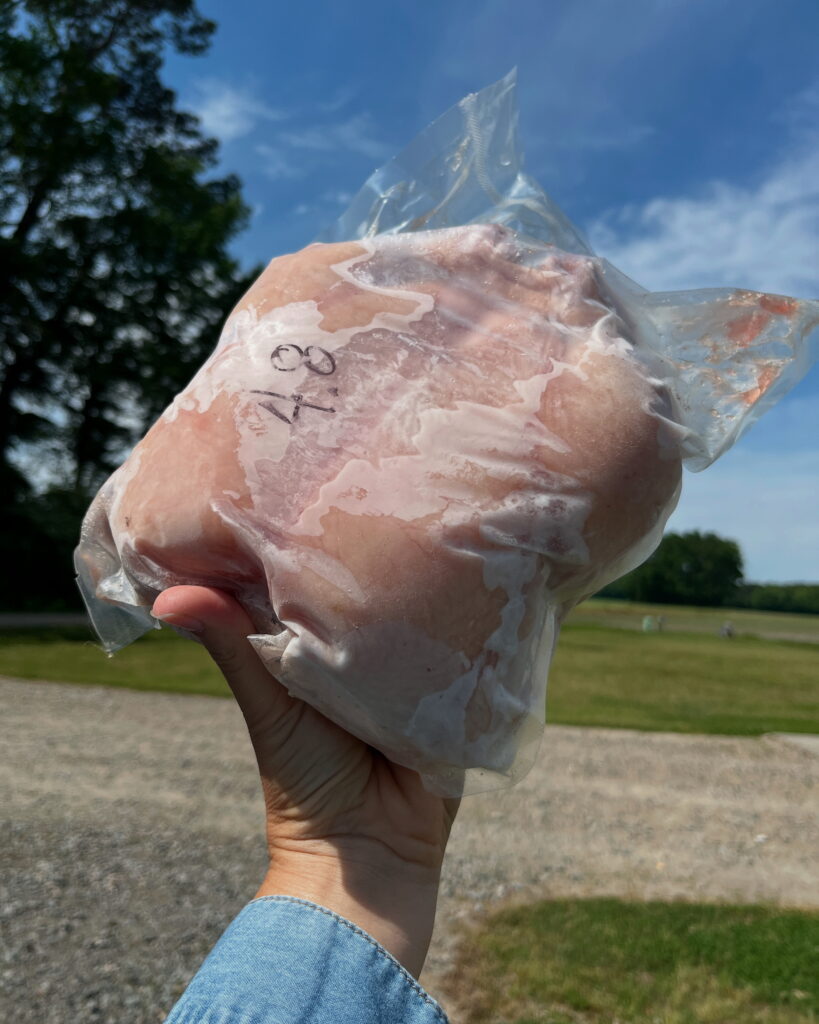
We are using a Vevor Vacuum Sealer to bag our meat chickens. Most of our birds weigh between 3.5 and 5.5 pounds. This is the weight we prefer our meat chickens.
What time of year do you process birds?
A wise friend once told me to choose my hard when it comes to processing chickens. She advised to work backwards on the calendar from when we want to process meat birds to find the hatch date.
You really do not want to be processing birds in the dead of summer, late July-early August in North Carolina. Shade or no shade. It’s just too hot… unless you start at 5am and don’t have many birds to do.
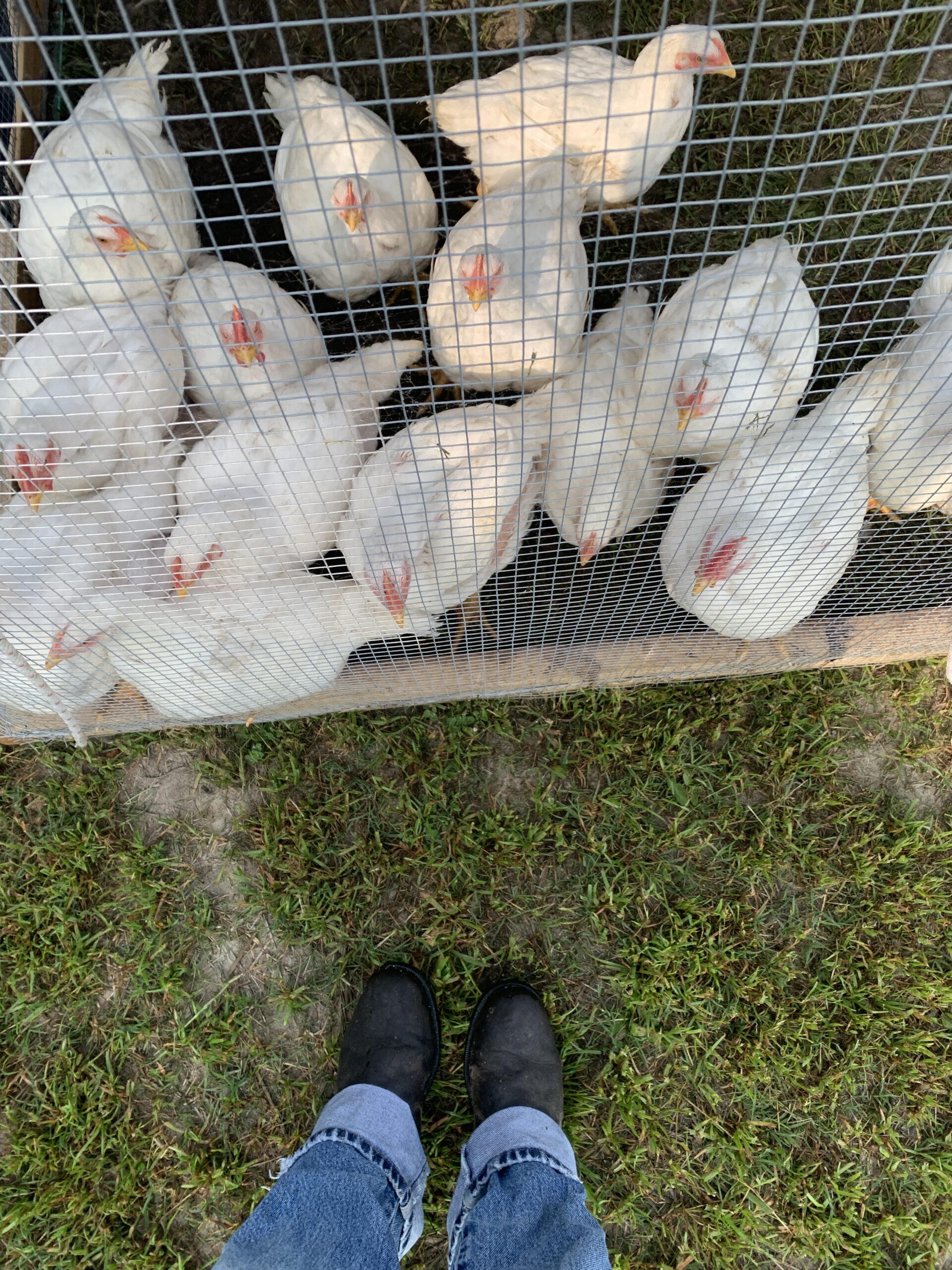
At Johnson Home, we choose to process before Memorial Day and before Thanksgiving. So this means our hatch dates are in mid-March and mid-September for meat chickens we grow out for 7-7.5 weeks to yield the 3.5-5.5 lb birds we prefer.
Our chicken processing set up allows us to begin processing at 8am and finish around 12 noon for about 50 birds and sometimes a couple turkeys. We offer free chicken processing classes to our local community. Free to come watch or to come learn hands-on. Often we have lots of help on processing day because the families we raise meat chickens for come help as well as others who just want to learn a new skill. The teaching, explaining, showing, plus the cleaning up at the end takes time.
Our stations have approximately 8-14 people helping on chicken processing day. A blessing, indeed! Many hands make light work!
If you have any questions or suggestions:
Please feel free to comment here to ask your question or leave your suggestions for us! We love learning new ways for chicken processing set up for efficiency. And we are happy to explain why we do anything you see here with our chicken processing set up or stations or raising meat chickens!
Check out these other posts about raising meat chickens:
RAISING MEAT CHICKENS ON OUR ONE ACRE HOMESTEAD

Follow along for more chicken content
Feel free to follow Johnson Home NC on Facebook, Instagram, Pinterest, and YouTube.
Allow me to slip into your email inbox weekly with kitchen, gardening, natural cleaning, and chicken raising real time happenings from our one acre North Carolina homestead right to you by joining our email list HERE.
Be sure to pin this post for later!